


Taking the Time for You.

South Beach, FL is Vero Beach’s southernmost barrier island community, where the Atlantic Ocean sits on one side and the Indian River Lagoon on the other, and the strip of land between them is narrow enough that the salt air never really lets up. It is a quieter, more private stretch of the island than the areas further north, with a mix of single-family homes and smaller residential properties that share one thing in common: HVAC equipment that is operating in some of the most corrosive outdoor conditions Indian River County has to offer. Bates Air and Heat is a veteran-owned company that takes calls in South Beach knowing exactly what the environment here does to a heat pump, and we come prepared to deal with it properly rather than work around it.
Salt air corrosion is a slow process that does not announce itself until it has already done real damage. By the time a heat pump in South Beach shows obvious symptoms, the underlying deterioration has often been underway for a season or more. Recognizing the earlier, quieter signals is what gives you the best chance of a manageable repair rather than an emergency replacement conversation. These are the ones worth taking seriously:
South Beach’s narrow barrier island setting means there is nowhere for the salt air to go except through and around your outdoor equipment every single day. The window between early warning and active failure is shorter here than in most other parts of the county.


South Beach occupies one of the narrowest sections of the barrier island south of Vero Beach proper, which means outdoor HVAC equipment here has essentially no buffer from ocean exposure regardless of where on the property it is installed. Units on the east side of a home face direct Atlantic salt air. Units on the west side draw air that has already crossed the length of the property and still carries significant chloride content. The Indian River Lagoon on the western edge adds its own layer of persistent humidity that keeps moisture levels elevated even when the ocean breeze dies down overnight. Homes in this community range from older concrete block construction from the 1960s and 1970s to more recent builds and renovations, and each generation of construction carries its own set of HVAC vulnerabilities under these conditions. The failure patterns we encounter most consistently in South Beach include:
South Beach’s environment does not give equipment a single day off from the pressure it applies. A repair approach that does not account for every one of those exposure points is going to leave the next failure already in progress when the current one gets fixed.
Servicing a heat pump in South Beach requires a different level of preparation than a standard residential call. We know before we arrive that salt air exposure is a variable in whatever we are going to find, and we bring that expectation into every part of the diagnostic and repair process. We do not patch the presenting problem and leave the corrosion conditions that caused it unaddressed. Here is the full scope of what our heat pump repair services cover in this community:
We offer maintenance agreements to South Beach homeowners with the strong recommendation that they be taken seriously. In an environment this aggressive, annual inspection is not a precaution. It is the minimum interval that makes sense given the pace at which salt air works on exposed equipment.

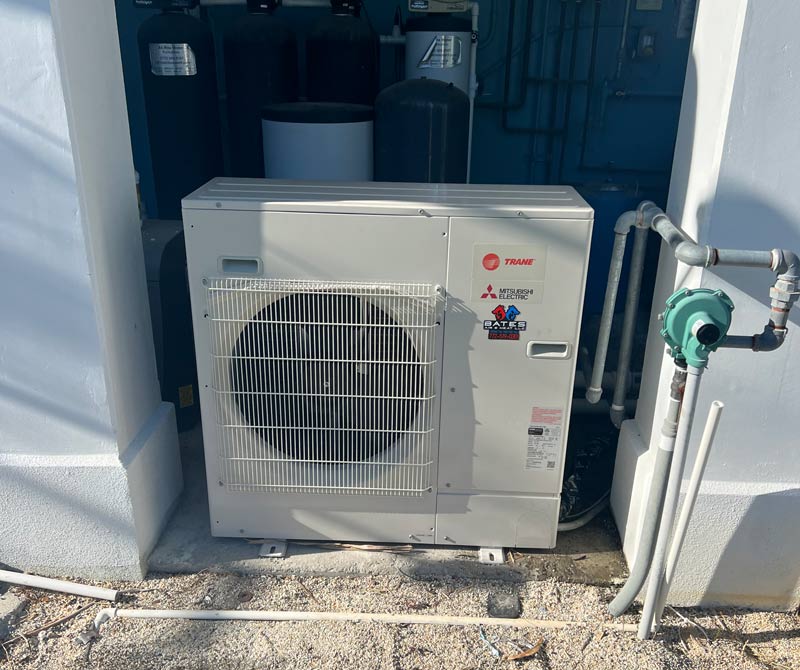
We received a call last summer from a homeowner named Frank who lives near the southern tip of South Beach. He had owned the property for several years and had always kept up with basic maintenance, but over the course of one particularly hot stretch in July he noticed the system was running almost around the clock without the house ever feeling genuinely cool. He had also seen the outdoor unit cycling off sooner than expected during operation and starting back up again within a couple of minutes. When we arrived and pulled the diagnostic, the condenser coil had deteriorated significantly on the ocean-facing side of the unit where direct salt air exposure was heaviest. The fin structure on roughly the lower half of that face had collapsed to the point where it was no longer contributing to heat transfer. The refrigerant charge was also low from a leak at a flare fitting on the suction line, and the contactor inside the outdoor electrical compartment had pitted contact surfaces that were causing the premature cycling Frank had noticed. We replaced the condenser coil, repaired the fitting, recharged the system to specification, and replaced the contactor while the unit was already open. We also applied a protective coil coating to the new condenser coil surface to slow the rate at which salt air would work on the replacement. Frank asked why the coating had not been applied to the original coil when the unit was installed. It is a fair question, and the honest answer is that protective coatings on coastal equipment should be standard practice but often are not. We make a point of recommending them every time we put new coil hardware into a South Beach home.
South Beach is not a community where you want to hand your HVAC system to someone who is going to treat it like any other residential call. The environment here demands specific knowledge, and Bates Air and Heat brings that knowledge to every job we take in this neighborhood. We are veteran-owned, which means we approach this work with a standard of accountability that does not bend based on how complicated or inconvenient a job turns out to be. When you call us in South Beach, here is what that commitment looks like in practice:
South Beach is a demanding environment for any piece of mechanical equipment, and the homeowners here deserve a repair company that understands that from the moment they pick up the phone. That is what we show up to deliver every time.


Stronger onshore wind carries higher concentrations of salt particles directly into the condenser coil and electrical compartment of the outdoor unit. If corrosion has already compromised the coil’s heat transfer efficiency or introduced resistance in electrical contacts, the added salt load on those days pushes a marginal system past its ability to keep up. It is one of the clearest indicators that salt-related deterioration has already progressed to a point where a diagnostic visit is overdue.
A coil coating creates a barrier between the aluminum fin surface and the salt-laden air that would otherwise work directly on the metal. It does not make the coil immune to corrosion, but it meaningfully slows the rate at which fin deterioration progresses. In a location like South Beach where unprotected coils can show significant degradation within a few years of installation, the cost of a coating is almost always justified by the extended service life it provides.
From the outside, you generally cannot tell. Moisture intrusion into the electrical compartment produces internal corrosion on terminals, contactor surfaces, and capacitor housings that is only visible when the compartment is opened and inspected. The symptoms it causes, intermittent startup failures, breaker trips, and erratic cycling, can be easy to attribute to other causes without opening the unit. We inspect the electrical compartment as a standard part of every service call on coastal equipment.
A new unit will face the same environment, but there are meaningful steps that slow the progression significantly. Selecting equipment with coil coatings designed for coastal exposure, applying additional protective treatment at installation, keeping the electrical compartment properly sealed, and maintaining a regular service schedule all extend the serviceable life of new equipment in a place like South Beach considerably beyond what an unprotected unit would deliver.
At minimum once a year, and twice a year is a defensible approach for units with direct ocean-side exposure. The pace of salt air corrosion in South Beach compresses the window in which developing problems can be caught and addressed before they require major component replacement. An inspection interval that might be perfectly adequate in an inland location simply does not keep up with what this environment demands.