


Taking the Time for You.

Most people only buy a handful of air conditioners in their lifetime, so it’s no surprise the process can feel unfamiliar. Between system types, efficiency levels, and sizing questions, it’s easy to feel like you’re guessing. At Bates Air and Heat, our job is to take the guesswork out of it and get the right system installed the right way.
We install central air systems, heat pumps, package units, and ductless systems for single-family homes, townhomes, and condos. Every installation begins with a load calculation and a look at your ductwork, insulation, electrical service, and the spot where the outdoor unit will live. Our veteran-owned team explains your options in plain terms, gives you an upfront quote, and handles everything from removal to final testing. When we’re done, you’ll have a system built to keep you comfortable and a team you can call when you need us.
After a rough storm season or a summer of nonstop running, it’s worth giving your air conditioner an honest look. Homes surrounded by water on so many sides deal with heavy humidity and salt, and both take a toll over time. These are the signs that usually point toward replacement:
A few of these together usually mean the system is near the end of its useful life. We’ll inspect it and help you decide whether to repair now or plan a replacement before the next storm season.


Every month, your power bill tells you how well your AC was installed. A system with the correct refrigerant charge, tight duct connections, and proper airflow reaches the efficiency it was built for, while one that was rushed can waste energy from the very first day. Over the life of the equipment, that gap adds up to real money.
Comfort is the part you feel. With the Indian River Lagoon on one side, the St. Lucie River to the south, and the ocean just across the island, moisture hangs in the air for much of the year. A correctly sized and installed system removes that humidity steadily, keeping rooms crisp instead of clammy and protecting your home from mildew.
Professional installation also gives you protection beyond comfort. A licensed install keeps your equipment warranty valid, meets local code, and includes the anchoring and electrical safeguards your system needs during hurricane season. That’s the kind of work that keeps paying you back long after the crew leaves.
We keep the process simple for you, even when the work behind it isn’t. It starts with an in-home evaluation where we measure rooms, check insulation and window exposure, inspect the ductwork, and confirm your electrical panel can support the new system. Older homes, especially those built before the 1970s, sometimes need electrical updates, and we’d rather find that out up front than on installation day.
Once you’ve chosen a system, we schedule a date and arrive ready to work. Our crew removes the old equipment, prepares the pad or stand for the new outdoor unit, and installs the indoor air handler, refrigerant lines, and condensate drain with an overflow safety switch. The outdoor unit is anchored for high winds and placed with flood risk in mind.
To finish, we vacuum and charge the system, check airflow and temperatures throughout the house, and program your thermostat. You’ll get a walkthrough of how everything works and a clear explanation of upkeep. We also offer maintenance contracts so your new system gets regular attention from the start.

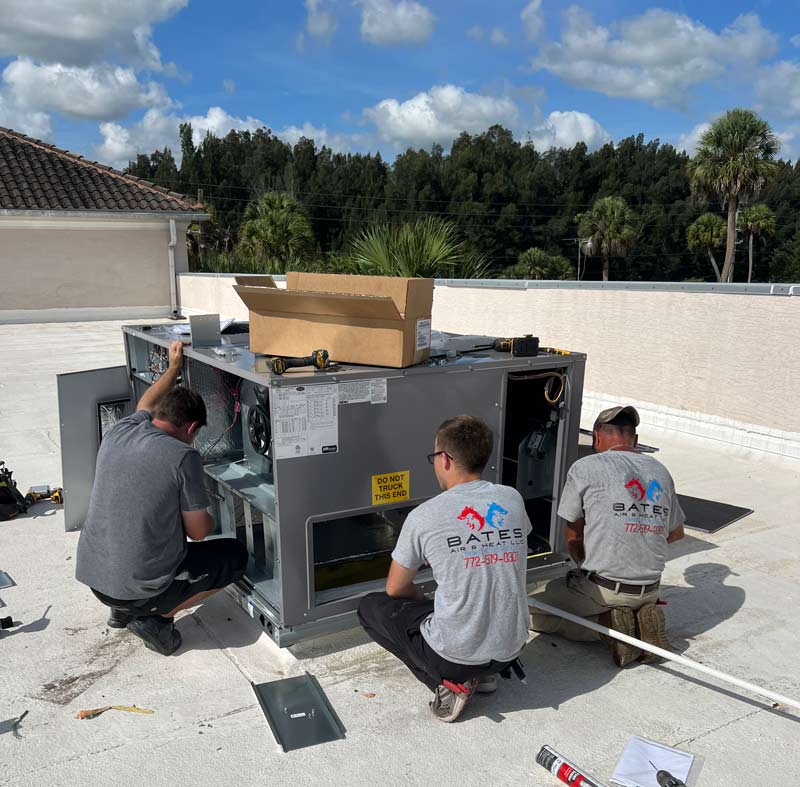
Living close to the water means planning for what storms can do to your air conditioner. Neighborhoods along the St. Lucie River like Rio, Rio St. Lucie Terrace, and Palmetto Grove sit low enough that heavy rain and storm surge can leave water standing around outdoor equipment, and homes near Indian River Point face similar exposure along the lagoon. Condos on Hutchinson Island add wind and salt spray to the mix.
Outdoor units in these areas fail in predictable ways. Floodwater reaches the compressor and electrical components, wind pushes poorly secured units off their pads, and power surges during outages and restoration fry control boards. Many older installations were set on ground-level pads with minimal anchoring, which leaves them vulnerable every time a tropical system passes through.
When we install AC on a waterfront or low-lying property, we look at the site before we pick a spot for the condenser. Where flooding is a concern, we raise the unit on a stand or platform to keep it above standing water. We anchor the equipment with tie-downs rated for high winds, recommend surge protection for the electrical side, and choose corrosion-resistant options for homes near salt water, so your system has a better chance of making it through storm season intact.
We’ve built our reputation one job at a time, and we treat every home like it’s the most important one on the schedule. Here’s what that looks like in practice:
When you’re ready for a system built to handle Jensen Beach weather, we’re ready to help. Call Bates Air and Heat to schedule your installation estimate.


If your home is in a low-lying or flood-prone area, raising the unit on a stand or platform helps keep it above standing water. We’ll assess your property and recommend the right setup.
The outdoor unit is secured to its pad or stand with straps or brackets rated for high winds so it can’t shift or tip over during a storm.
Yes. We work within association rules and tight mechanical spaces, and we recommend corrosion protection for units close to the ocean.
Often, yes. Storms and power restorations can send surges that damage control boards and compressors, and a surge protector adds an extra layer of defense.
Turn the system off at the thermostat and breaker, clear loose items around the outdoor unit, and have it checked before restarting if it was exposed to flooding.
We use cookies to improve your experience on our site. By using our site, you consent to cookies.
Manage your cookie preferences below:
Essential cookies enable basic functions and are necessary for the proper function of the website.
You can find more information in our Cookie Policy and .